In France you can't buy stewing steak already cut into pieces, so I bought a delicious kilo of featherblade (paleron in French)- so-called because each slice looks like a feather- and decided to butcher it myself, with a little help from Andrew over facetime! I shall provide tips here for what is quite simple butchery if you have the time and patience; if you perish the thought then just buy a kilo of already diced chuck or featherblade steak and skip to where I put it all together in the casserole dish!

This cut is a lot cheaper in England than in France, about £10.99 a kilo in Andrew's and gives eight good portions, so is amazing value for money. Even better that line of fat, that makes the blade of the "feather", which I cut out and add to the stew, gives the most amazing flavour... with the vegetables, a bay leaf and a few cloves (my magical ingredient in all stews) this dish is quite simply beautiful winter soul food.
You will need...
1 kilo featherblade steak in a piece, or diced by your butcher, or 1 kilo any stewing steak from a butchers so you know that it's well matured and full of flavour | 1 clove of garlic | 1 shallot | 1 stick of celery | 1 leek | 1 carrot | 3 tomatoes | 1 litre of chicken or beef stock | 3 cloves | 2 bay leaves

1 Pre heat the oven to 160C. Chop the shallot, garlic and celery and fry in a large casserole dish on a gentle heat.

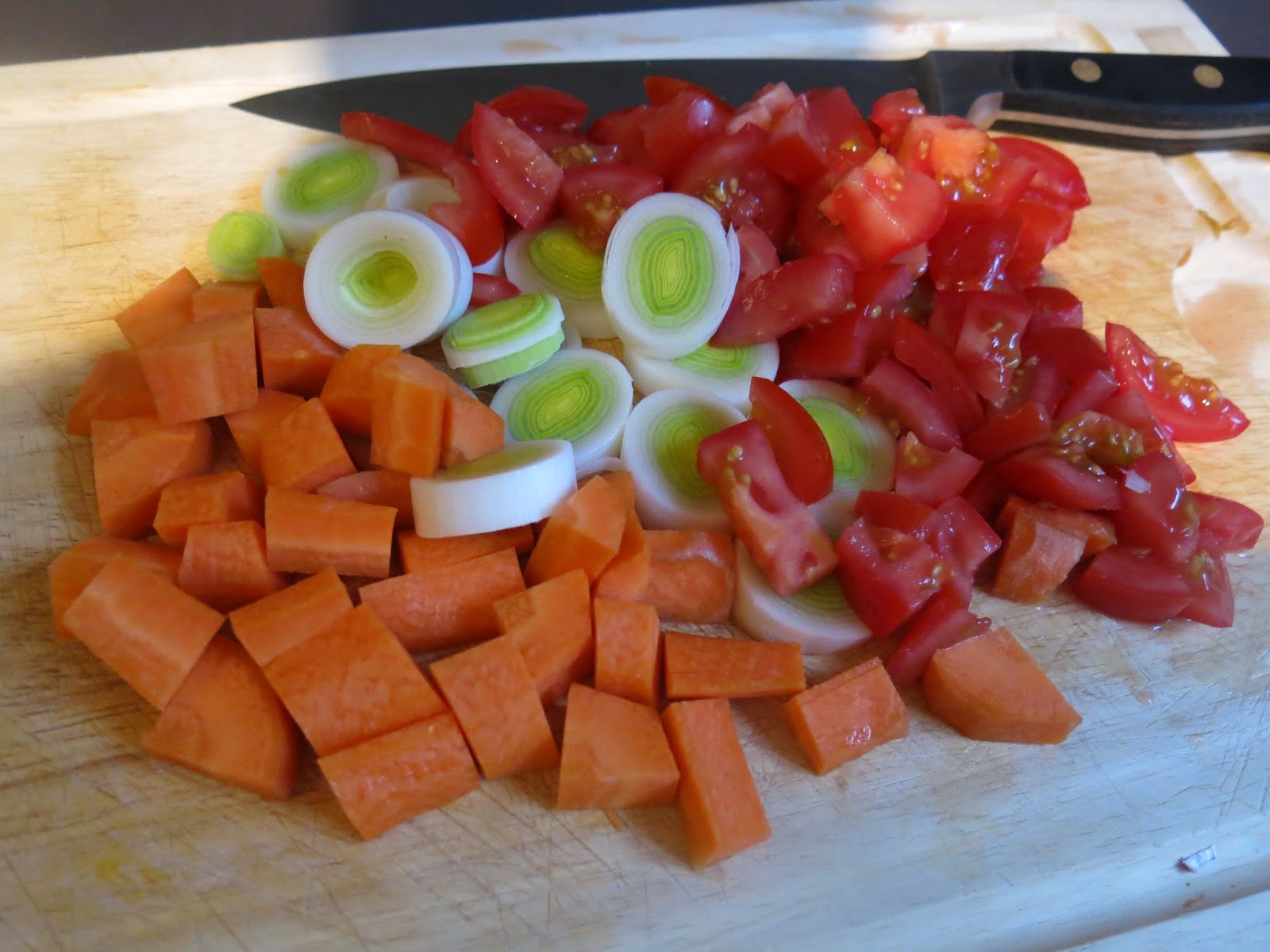
2 Meanwhile chop the carrot, celery and tomatoes and add to the pan.
3 If you're dicing/preparing your own piece of beef, turn off the heat, as it might take a little while. SKIP TO STEP 7 if you're not preparing yourself!
4 Lay your piece of featherblade flat, fat side up. Try gently pulling the fat from one of the corners, gently using the point of a very sharp knife to help lift it slightly. At the point you should see the fat lifting, leaving a thin layer of membrane underneath, this is ok and can be left on- it will disappear when you cook the beef.

So continue running that point of the knife down the line that is made between where the membrane and fat meet, while you are gently pulling the fat away with the two hands. If you just relax you'll find the two actions helping each other: as opposed to cutting into the meat you are releasing that layer of fat, to enable you to pull it away.

5 Fat removed, we need to take out that feather "blade" which is a sheet/piece of grizzle that runs through the cut. Again patience and using the point of the knife in a gentle manner is key. The action remains the same, although it feels a little more tricky, removing something from inside. So start slow running the point of the knife, down the line of the grizzle so you've got something to hold on to a little.

Once you have that it becomes a little easier to use the knife to help you pull the fat away from the meat as opposed to slicing into the meat and hoping for the best. You want to have as little meat on that fat as possible, you don't want to waste anything. Just relax and feel your away around. Once you have cut away quite a lot nearest to the edge- the side where my hand is in the picture- you can make a cut down that side of the meat so that you are able to begin to open up the meat. This just makes it easier to see what's going on in there!

It's not the end of the world if you leave more meat on the fat than wanted but have a little look at this next picture to see what you're aiming for!

6 So fat and grizzle placed to one side, and the piece of meat opened up, you can start dicing it.

Cut into two pieces, then cut long strips and just dice across. You don't want pieces too small because the meat is so tender they will just cook down into mush.

7 Turn the heat back on and add the diced meat to the pan as well as the cloves, bay leaves and stock. Top up with water if the meat isn't covered. Bring to the boil and place in the preheated oven with the lid on.

8 The meat will definitely be cooked after two hours, and if you want to eat at this stage I would mix up about a tablespoon of cornflour (gluten free) in the same amount of melted butter, with a little water added, and stir this into the casserole, bringing the cassserole to the boil on the hob to reduce that sauce down.

9 If you can wait, I would reduce the heat on the oven to 110C and cook for another two hours. You can then remove the two pieces of fat if they haven't completely melted away and also the bay leaves and cloves and then serve with rice or mashed potato. Each time you heat that casserole up during the week it is going to reduce down even more and become even more delicious.
.JPG)
1 Pre heat the oven to 160C. Chop the shallot, garlic and celery and fry in a large casserole dish on a gentle heat.
2 Meanwhile chop the carrot, celery and tomatoes and add to the pan.
3 If you're dicing/preparing your own piece of beef, turn off the heat, as it might take a little while. SKIP TO STEP 7 if you're not preparing yourself!
4 Lay your piece of featherblade flat, fat side up. Try gently pulling the fat from one of the corners, gently using the point of a very sharp knife to help lift it slightly. At the point you should see the fat lifting, leaving a thin layer of membrane underneath, this is ok and can be left on- it will disappear when you cook the beef.
So continue running that point of the knife down the line that is made between where the membrane and fat meet, while you are gently pulling the fat away with the two hands. If you just relax you'll find the two actions helping each other: as opposed to cutting into the meat you are releasing that layer of fat, to enable you to pull it away.
5 Fat removed, we need to take out that feather "blade" which is a sheet/piece of grizzle that runs through the cut. Again patience and using the point of the knife in a gentle manner is key. The action remains the same, although it feels a little more tricky, removing something from inside. So start slow running the point of the knife, down the line of the grizzle so you've got something to hold on to a little.
Once you have that it becomes a little easier to use the knife to help you pull the fat away from the meat as opposed to slicing into the meat and hoping for the best. You want to have as little meat on that fat as possible, you don't want to waste anything. Just relax and feel your away around. Once you have cut away quite a lot nearest to the edge- the side where my hand is in the picture- you can make a cut down that side of the meat so that you are able to begin to open up the meat. This just makes it easier to see what's going on in there!
It's not the end of the world if you leave more meat on the fat than wanted but have a little look at this next picture to see what you're aiming for!
6 So fat and grizzle placed to one side, and the piece of meat opened up, you can start dicing it.
7 Turn the heat back on and add the diced meat to the pan as well as the cloves, bay leaves and stock. Top up with water if the meat isn't covered. Bring to the boil and place in the preheated oven with the lid on.
8 The meat will definitely be cooked after two hours, and if you want to eat at this stage I would mix up about a tablespoon of cornflour (gluten free) in the same amount of melted butter, with a little water added, and stir this into the casserole, bringing the cassserole to the boil on the hob to reduce that sauce down.
9 If you can wait, I would reduce the heat on the oven to 110C and cook for another two hours. You can then remove the two pieces of fat if they haven't completely melted away and also the bay leaves and cloves and then serve with rice or mashed potato. Each time you heat that casserole up during the week it is going to reduce down even more and become even more delicious.


